Lymphoma, a look from the laboratory
By: Dr. Vanessa Santiago Pacheco.
Medical Pathologist, Laboratorio Clínico Hematológico S.A. Medellín, Colombia.
Published on 09/09/2021
Lymphoma is a type of cancer of the lymphatic system and blood that affects a specific group of white blood cells, the lymphocytes, and can involve the tissue they make up (lymphoid tissue) in organs of the immune system such as the lymph nodes, bone marrow, thymus and spleen (1).
This condition is produced by alterations in the normal development of white blood cells, which cause failures in their functioning and lead to their abnormal and uncontrolled division (2). When these lymphocytes undergo malignant transformation they form masses or increase the size of the affected organs, mainly the lymph nodes (adenomegaly), although it can affect almost any organ.
There are different types of lymphoma according to the type of cell affected and its clinical behavior. The diagnosis, management and follow-up of the disease depend on these differences. A simple way to classify them is in Hodgkin and Non-Hodgkin lymphomas (3).
In Hodgkin's lymphoma, the diagnostic neoplastic cells are called Reed-Sternberg and Hodgkin cells. This lymphoma can occur in people of all ages, the most affected being adolescents/young adults and those over 75 years of age (3).
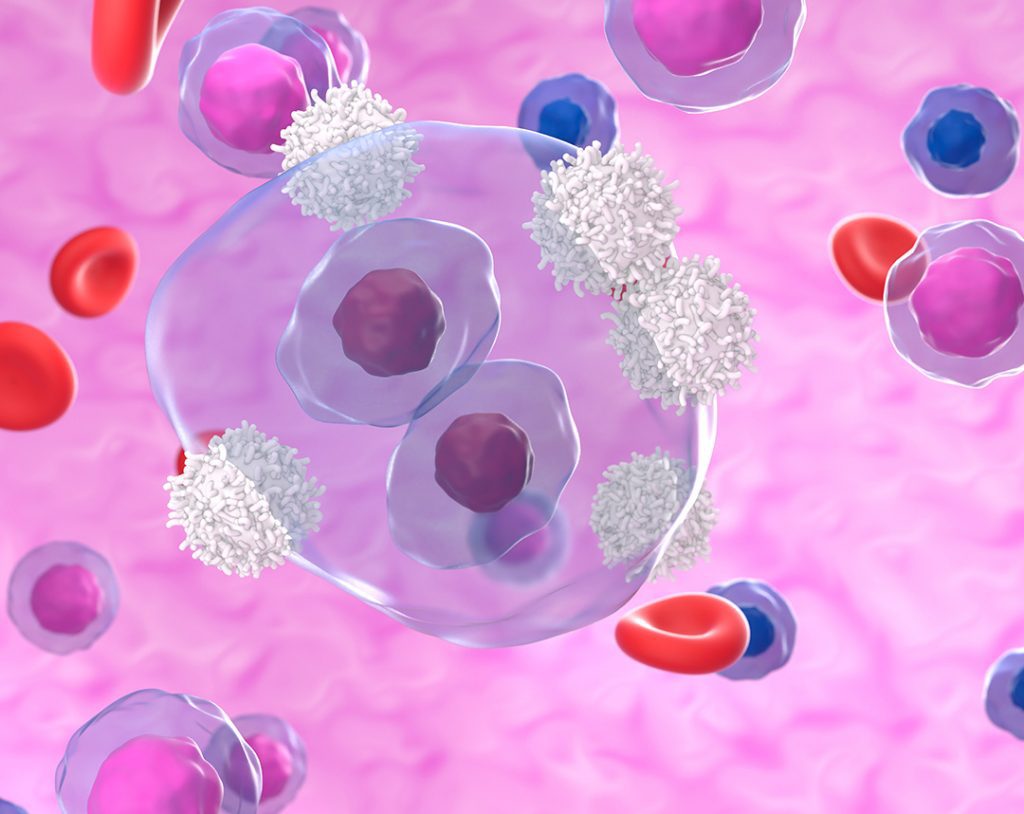
The term non-Hodgkin's lymphoma encompasses a very diverse group of neoplasms, which are classified according to their cell of origin (e.g. T lymphomas or B lymphomas), clinical behavior (low or high grade) and, in recent years, according to their etiology or associated factors (immunodeficiency-associated lymphomas). This diversity means that the presentation of the disease, its symptoms, diagnosis and treatment vary in each patient and that adequate management depends on an accurate and efficient diagnosis.
Symptoms
The most common symptom in lymphoma is enlarged lymph nodes that often present as palpable masses in the neck, above the collarbones, in the armpits, groin or other parts of the body. Occasionally, the growth of these lymph nodes can press on nearby organs and cause chest pain, coughing, shortness of breath and abdominal pain (2). Other common symptoms are fever, weight loss, night sweats. In some low-grade lymphomas, symptomatology is mild and may not be apparent because of the indolent behavior of these lymphomas.
It is very important to mention that several of these symptoms can also be caused by benign, reactive, inflammatory or infectious processes, therefore, a comprehensive analysis should always be performed and complemented with diagnostic tests.

Diagnosis
For early diagnosis and proper management it is necessary to be managed by a team of professionals, led by a specialist in hematology, who must interrogate, examine, analyze, order tests and perform procedures, in order to subsequently define the management plan.
The diagnostic battery includes blood tests, radiological images and biopsy of the affected organ, as well as additional studies, which in addition to diagnosis, report the patient's general condition and evaluate possible systemic involvement.
Some of the diagnostic tests in the study of lymphoma are lymph node biopsy, bone marrow aspirate and biopsy, flow cytometry, blood count, computed tomography (CT), including genetic testing in some cases.

Management
Chemotherapy is the main form of treatment, with schedules depending on the type of lymphoma and, in some cases, on specific genetic findings. Some patients benefit from radiotherapy and targeted biologic therapies; in others, bone marrow transplantation may be the indicated treatment.
The treatment of lymphomas commonly gives rise to side effects that vary in severity according to each patient and the treatment received. These can be: fever, constipation, easy tiredness, cough, difficulty breathing, hair loss, symptoms associated with anemia such as pallor, oral ulcers, nausea, vomiting, loss of appetite or weight loss (2).
In the world
Governmental and non-governmental organizations have developed strategies for the comprehensive care and management of lymphoma patients.
The World Health Organization (WHO), through the International Agency for Research on Cancer (IARC), continuously updates the classification of all malignancies, including hematological malignancies, and their potential causative agents. It also monitors the political commitment of nations to cancer prevention and control, coordinates research to evaluate the causes and mechanisms of action of cancer, and monitors cancer incidence (4), through initiatives such as GLOBOCAN, the Global Cancer Observatory, which is an interactive Web platform that presents global cancer statistics to inform cancer control and research (5).
In many countries there are non-governmental organizations that are responsible for looking after the interests of patients, in addition to providing funds for research, diagnosis, treatment and follow-up. In the United Kingdom, Blood Cancer UK (6), a private organization that was created in 1960 as a community dedicated to the fight against hematological neoplasms, has financed research for the development of innovative treatments and provides emotional and economic support for patients. In the United States there is the Lymphoma Foundation of America (7), a charitable organization that provides free programs and services for patients with hematological malignancies, as well as financing scientific studies on the subject, prioritizing the development of new treatments, the identification of causes and the possibility of preventing lymphoma (8).
In Colombia, the Colombian Leukemia and Lymphoma Foundation is a non-profit organization whose members are dedicated to providing psychosocial support, information and representation to patients with hemato-oncological diseases and their families, with education about the disease and the Colombian health system (9) .
On September 15, World Lymphoma Day is commemorated to raise awareness, orient and inform the general population about this type of cancer, as well as to promote its early and timely diagnosis.

In the Laboratorio Clínico Hematológico
At Laboratorio Clínico Hematológico we have specialized diagnostic medicine services based on modern standards of practice. Our Diagnostic Hematology Division is an option for a global, humanized and integrated approach to the hematology patient, bringing signs and symptoms to the clinical laboratory and pathology perspective, articulating the results with the treating hematologist to achieve a timely and optimal management of our patients.
Among the laboratory hematology services we offer are basic and specialized tests for the diagnosis and follow-up of patients with lymphoma (10) . The state-of-the-art blood count is an essential test for the ongoing assessment of patients. Flow cytometry, with high analytical sensitivity and specificity, allows the characterization and classification of cells in a sample for accurate and timely diagnosis of lymphomas and leukemias (11).
Additionally, we offer morphological studies in blood, bone marrow, lymph nodes, among other tissues, performed by our team of pathologists trained in hematopathology and essential in the diagnosis, which allow a complete analysis of high quality. Among them are: reading and interpretation of peripheral blood smears and bone marrow aspirates; evaluation and interpretation of bone marrow biopsy, lymph nodes and other tissues; special staining and immunohistochemistry for disease classification. The findings of these studies are analyzed together in an integrated and patient-focused manner to provide a report of value to the management and clinical benefit of the patient.
On the other hand, the Laboratory has a new Bone Marrow Aspirate and Biopsy service, performed with all the quality standards by a highly experienced Hematologist, for patients who require the procedure on an outpatient basis. This allows a better opportunity in the result, in addition to a complete clinical and diagnostic integration, achieving our goal of being a comprehensive Diagnostic Hematology service for the overall benefit of our patients.
Bibliography
- Did you know there is a type of cancer called lymphoma? https://www.fsfb.org.codz/d5/L2dJQSEvUUt3QS80TmxFL1o2X1BPSDQxMzQwTThFRUIwUU85QVBIVlYyNEoy/.
- Blood Cancer UK | Lymphoma. Blood Cancer UK https://bloodcancer.org.uk/understanding-blood-cancer/lymphoma/.
- Blood Cancer UK | Hodgkin lymphoma. Blood Cancer UK https://bloodcancer.org.uk/understanding-blood-cancer/lymphoma/hodgkin-lymphoma/.
- Cancer. https://www.who.int/news-room/fact-sheets/detail/cancer.
- Global Cancer Observatory. https://gco.iarc.fr/.
- Blood Cancer UK | About us. Blood Cancer UK https://bloodcancer.org.uk/about-us/.
- Lymphoma Foundation of America- lymphomahelp.org. https://www.lymphomahelp.org/.
- Lymphoma Foundation of America- lymphomahelp.org. https://www.lymphomahelp.org/lymphoma.htm.
- Colombian Foundation of Leukemia and Lymphoma - Funcolombiana Of Leukemia Lymphoma in Bogota. Reference center in Colombia on leukemia and lymphoma. The best option in orientation and support for .... https://www.funleucemialinfoma.org/.
- Clinical Laboratory. Laboratorio Clínico Hematológico https://lch.co/laboratorio-clinico/.
- Flow cytometry. Laboratorio Clínico Hematológico https://lch.co/citometria-de-flujo/.