Test
BiofireⓇ FilmArrayⓇ Panels.
BiofireⓇ FilmArrayⓇ panels for molecular diagnosis of acute gastrointestinal infections.
By: Jairo A. Mesa Arango*, Natalia Loaiza Díaz**, Natalia Loaiza Díaz**.
* Molecular Laboratory Scientist, PhDc in biology, Laboratorio Clínico Hematológico S.A. Medellín, Colombia.
** Head of Clinical Pathology, Medical Specialist in Microbiology, Laboratorio Clínico Hematológico S.A. Medellín, Colombia.
Published on 01-06-2021
Acute gastroenteritis and foodborne illness (ATE) are a frequent cause of illness and death worldwide, and the leading cause of diarrheal disease in children under 5 years of age. Gastrointestinal (GI) conditions of infectious origin result from the consumption of water and food contaminated with viruses, bacteria and parasites. These infections, usually accidental, occur worldwide; however, they occur more frequently in regions of developing countries where hygienic-sanitary measures are insufficient or where access to sanitation and drinking water is limited. (1,2).
According to data published by the World Health Organization (WHO) in 2015, about 600 million cases and 420,000 deaths occur each year from GI conditions, 30% of which affect children under 5 years of age (1,3). In Colombia, according to data reported by the National Institute of Health (INS), in 2019, 997 ATE outbreaks were reported, with a total of 11,222 people affected. Among these, the most affected age group was 20 to 49 years old, followed by children and young people between 10 and 19 years old. In addition, about half of these situations occurred at home and the rest in restaurants, schools and places that favor close contact between people. It is important to highlight that 21.4% (2,401) of these cases occurred in the department of Antioquia alone. (4).
GI of infectious origin are caused by a wide variety of bacteria, viruses and parasites (e.g. Norovirus sp, Campylobacter spp, Salmonella enterica no typhy, enteropathogenic Escherichia coli enteropathogenic, Taenia solium, Giardia sp, among others) and can manifest themselves in different ways, causing from mild diarrhea that does not require treatment to situations of difficult management that can put the patient's life at risk, such as hemolytic uremic syndrome and pseudomembranous colitis. In these cases, specific and rapid identification of the pathogen causing the clinical picture is essential to define or adjust pharmacological and non-pharmacological therapy and contain possible outbreaks of infection. (4,5).

Diagnosis of gastrointestinal infections in clinical laboratories
Traditional diagnosis
Microbiological diagnosis of gastrointestinal infections caused by bacteria, fungi, viruses and parasites has traditionally focused on direct microscopic visualization and culture of the microorganisms present in fecal material. In this way, their isolation and identification is achieved through the study of phenotypic and biochemical characteristics, and the range of susceptibility to antimicrobials, which allows establishing the diagnosis and performing a timely clinical and pharmacological management. (6,7).
Traditional methodologies can be complemented with serological tests that directly or indirectly detect antigens of the microorganism under study, or antibodies against it, present in blood, serum or body fluid samples. This type of tests are of special relevance in cases of infections caused by viruses, which are difficult to detect due to their small size (which makes their microscopic visualization difficult) and their complexity for handling by culture techniques (6,7).
Traditional microbiological procedures continue to be the methods of choice for routine laboratory diagnosis, as they are cost-effective and cover the diagnosis of a significant number of infections caused by pathogenic agents or microorganisms. However, they present multiple limitations such as the execution of laborious protocols and extensive workflows (24-48 hours on average, and even days).55 , limited performance (sensitivity/specificity), limited application in the study of microorganisms that cannot be cultured by conventional methods and the difficulty of achieving a definitive diagnosis. The above, added to the variations that can be induced due to the technique used, the type of sample, the pathogen sought and its concentration in the sample. In addition, its detection capacity is limited to one or at most two types of pathogens simultaneously. (8,9).

Molecular diagnostics
Molecular techniques have revolutionized the way infections are diagnosed, since they allow the simultaneous detection of different species of microorganisms in the same assay (single or polymicrobial infections) and the massive study of samples. Molecular tests can be applied directly to clinical samples from patients for the detection of the nucleic acids (DNA/RNA) present, from which taxonomic identification (genus, species and subspecies or variants of the microorganism) and molecular characterization of the agent(s) involved for diagnostic purposes is possible (10).
Currently, techniques based on molecular biology allow cost-effective diagnosis, with greater sensitivity and specificity, and less expensive than traditional microbiological tests. Molecular diagnostic tests, in addition to favoring rapid typing of non-culturable pathogenic microorganisms, allow quantification of the microorganisms identified and detection of genes associated with antimicrobial resistance in a matter of hours, which significantly reduces the time it takes to obtain results (8-12 hours on average) and facilitates the management and timely treatment of infections by medical personnel (9,10). (9,10).
** Recently, molecular tests have been developed for the identification of pathogens that commonly cause GI infections. For the most part, these tests use the polymerase chain reaction (PCR) technique to detect specific regions of the genome (DNA/RNA) of multiple microorganisms of clinical or epidemiological interest, allowing for highly sensitive and specific genus or species level identification (9-11).
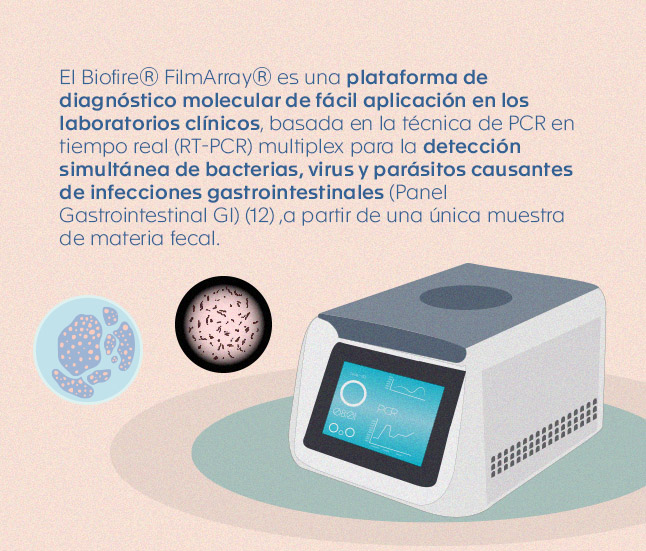
The BiofireⓇ FilmArrayⓇ is a molecular diagnostic platform for easy application in clinical laboratories, based on the multiplex real-time PCR (RT-PCR) technique for the simultaneous detection of bacteria, viruses and parasites causing gastrointestinal infections (Gastrointestinal GI Panel) (12) from a single stool sample. The workflow includes short sample handling and preparation times (2-5 minutes) and the automated run takes between 45 and 90 minutes from assembly to analysis and reporting, which guarantees fast and reliable results with diagnostic utility for these infections. (13).
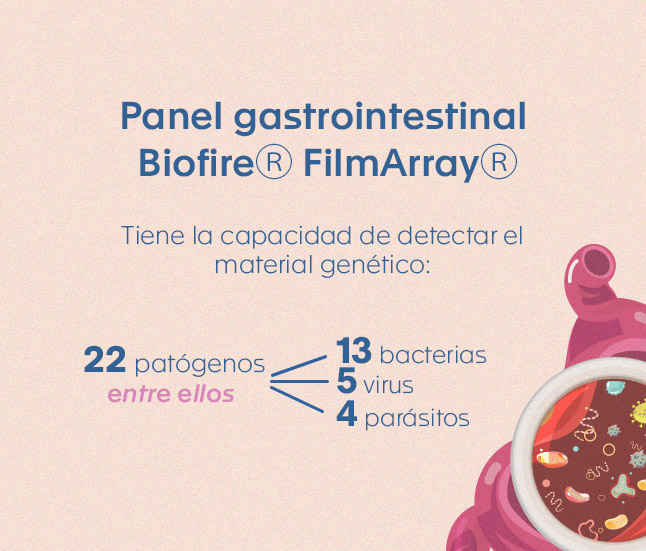
Gastrointestinal (GI) Panel BiofireⓇ FilmArrayⓇis a molecular tool that supports the diagnosis of gastrointestinal infections specifically caused by pathogenic microorganisms. This test allows for the detection in vitro of the nucleic acids of multiple bacteria, viruses and parasites directly in stool samples preserved in transport medium. Cary Blair transport medium and obtained from individuals with suspected or symptomatic gastrointestinal infection. The GI panel has the ability to detect the genetic material of 22 pathogens, including 5 viruses, 13 bacteria, and 4 parasites (13).
The viruses detected with the test correspond to: Adenovirus F 40/41, Astrovirus, Norovirus GI/GII, Rotavirus A and Sapovirus (Genogroups I, II, IV, and V). The test also detects parasites including: Cryptosporidium spp, Cyclospora cayetanensis, Entamoeba histolytica y Giardia lamblia (also known as G. intestinalis y G. duodenalis). Finally, the 13 bacteria detected in the test are: Campylobacter (C. jejuni/C. coli/C. upsaliensis), Clostridium difficile (C. difficile) toxin A/B, Plesiomonas shigelloides, Salmonella spp., Vibrio (V. parahaemolyticus/V. vulnificus/V. cholerae), including specific identification of Vibrio cholerae, Yersinia enterocolitica, Escherichia coli enteroaggregative (EAEC), Enteropathogenic Escherichia coli enteropathogenic Escherichia coli (EPEC), Enteropathogenic Escherichia coli Enterotoxigenic Escherichia coli (ETEC) lt/st, Shiga toxin-producing Escherichia coli Shiga toxin-producing Escherichia coli (STEC) stx1/stx2, including specific identification of E. coli serogroup O157. E. coli within STEC and Shigella/Escherichia coli enteroinvasive (EIEC) (12,13).
The detection and identification of specific viral, bacterial and parasitic nucleic acids in fecal samples from individuals with signs or symptoms of acute gastrointestinal infection indicates the presence of the microorganism whose genetic material was detected and supports the diagnosis and treatment of gastrointestinal infection when correlated with clinical and epidemiological findings. Positive results in this panel do not rule out simultaneous infection with microorganisms that are not included in this panel. Negative results may be due to the absence of the pathogen evaluated in the panel, its RNA or DNA being below the detection limit of the test, the presence of infections caused by pathogens not included in the GI panel, as well as possible problems in the preanalytical phase and preparation of the stool sample in the transport medium (13).
** At Laboratorio Clínico Hematológico we have available the GI BiofireⓇ FilmArrayⓇ panel:
- Verified according to the requirements of national and international regulatory bodies.
- It uses the multiplex RT-PCR technique for the detection of gastrointestinal pathogens.
- Results can be obtained in less than two (2) hours.
- It is performed from a stool sample that can be delivered to any of our locations in less than 2 hours after collection, if not preserved in the means of transport. Cary Blairor during the course of the day if it is preserved in the transport medium.
** In conclusion, the use of multiplexed panel-type diagnostic tests such as the Biofire.Ⓡ FilmArrayⓇ allows timely and certain establishment of the pathogens most commonly implicated in gastrointestinal infections, supports medical personnel in defining in a timely manner the pharmacological treatments and clinical-epidemiological behaviors necessary for the rapid rehabilitation of patients, while preventing the spread of infections to others and controlling ongoing outbreaks. This results in the reduction of health care costs due to unnecessary admissions and treatments (e.g., reduction of hospital stay), in the reduction of antibiotic resistance due to unnecessary prescription and use (e.g., use of drugs with no clinical utility in viral infections), and in the rational and efficient use of health care resources (10,12-16). (10,12-16).
Bibliography
- Caldas Arias L. Acute diarrheal disease. Rev Salud. 2020;03:7.
- Troeger C, Blacker BF, Khalil IA, Rao PC, Cao S, Zimsen SR, et al. Estimates of the global, regional, and national morbidity, mortality, and aetiologies of diarrhoea in 195 countries: a systematic analysis for the Global Burden of Disease Study 2016. Lancet Infect Dis. 2018;18(11):1211-28.
- World Health Organization. WHO estimates of the global burden of foodborne diseases: foodborne disease burden epidemiology reference group 2007-2015. Geneva, Switzerland: WHO Press; 2015. 255 p.
- Zarate AC. Foodborne disease outbreak investigation. 2020;03.
- Sotelo-Coronado JI, Flores-Aréchiga A, Llaca-Díaz J, Pérez-Chávez F, Lozano-Quintanilla S, Casillas-Vega N. Review: Associated microorganisms to gastrointestinal infections. Rev Latinoam Patol Clin Med Lab. 2016;63(4):206-10.
- Bou G, Fernández-Olmos A, García C, Sáez-Nieto JA, Valdezate S. Bacterial identification methods in the microbiology laboratory. Enfermedades Infecc Microbiol Clínica. 2011;29(8):601-8.
- Vila J, Álvarez-Martínez MJ, Buesa J, Castillo J. Microbiological diagnosis of gastrointestinal infections. Clinical Microbiol Infecc Diseases. 2009;27(7):406-11.
- Khardori N. Future of diagnostic microbiology. Indian J Med Microbiol. 2014;32(4):371-7.
- Vira H, Bhat V, Chavan P. Diagnostic Molecular Microbiology and its applications: Current and Future Perspectives. Clin Microbiol Infect Dis. 2016;1(1):20-31.
- Buchan BW, Ledeboer NA. Emerging technologies for the clinical microbiology laboratory. Clin Microbiol Rev. 2014;27(4):783-822.
- Amjad M. An Overview of the Molecular Methods in the Diagnosis of Gastrointestinal Infectious Diseases. Int J Microbiol. 2020;2020.
- Piralla A, Lunghi G, Ardissino G, Girello A, Premoli M, Bava E, et al. FilmArrayTM GI panel performance for the diagnosis of acute gastroenteritis or hemorrhagic diarrhea. BMC Microbiol. 2017;17(1):1-10.
- BioFire Diagnostics. FilmArray Quick Guide TM Gastrointestinal Panel.
- Balsalobre-Arenas L, Alarcón-Cavero T. Rapid diagnosis of gastrointestinal tract infections by parasites, viruses and bacteria. Clinical Microbiol Infecc Diseases. 2017;35(6):367-76.
- Lozano C, Torres C. Update on Gram-positive antibiotic resistance. Clinical Microbiol Infecc Diseases. 2017;35:2-8.
- Vila J, Gómez MD, Salavert M, Bosch J. Rapid diagnostic methods in clinical microbiology: clinical needs. Clinical Microbiol Infecc Diseases. 2017;35(1):41-6.